
“Pavements can be an extreme sport with a pushchair” - Part 4 of the Living in Tbilisi Series
Welcome to part four of our ‘Living in Tbilisi’ interview series with expat parents. This round we speak to Daria, who is well known for her blog and online moms’ group, “Mother in Georgia”, which takes an honest, informative and often humorous look into the daily realities of raising kids in Georgia.
Daria (aka ‘Dariko’) | Ukrainian | Wine educator, writer, tour planner, and founder of Patara Samkaro Publishing and Mother in Georgia
1. When did you arrive in Georgia?
I moved to Georgia in 2013, so this year marks 13 years of living here. I arrived as a young Ukrainian who was fascinated by Georgia and travel. Now I have a Georgian husband, two children, several projects here and a life that is definitely rooted in Tbilisi.
2. How many children do you have and what are their ages?
I have two boys: one is 4.5 and the other has just turned one. I find the difference very comfortable!
3. What was your reason for moving here?
The short answer is that I fell in love with Georgia. Before moving here permanently, I was already travelling here several times and writing about Georgia under the name Dariko Mogzauri — basically, "Dariko the Traveller". I was fascinated by how much there was to discover in such a small country, and at some point, moving here felt like the natural thing to do.
What I definitely didn't know in 2013 was that Georgia would eventually become the centre of my professional life too. I went on to work in tourism, contribute to the development of Georgia's National Tourism Strategy, co-found a wine tourism company, write a guidebook to Georgia's wine regions and eventually become a wine educator. So the move worked out rather more seriously than expected, and the ancient wine culture of Georgia was the reason!
4. What surprised you most about living in Georgia?
How easy it is to become involved in things here. Georgia is a relatively small country, and if you are curious and willing to participate, you very quickly stop being just an observer. Over the years I've somehow found myself involved in tourism, wine, education and now children's publishing.
And then there is the Georgian ability to know someone who knows someone. You can spend two hours trying to solve something officially and then discover that your neighbour's aunt knows exactly the person you need.
Also, how much people love kids and how poorly the infrastructure is handling the children’s needs. This is a big downside that makes me angrier than I admit.
5. Which neighbourhood in Tbilisi do you love the most, and why?
I have a soft spot for the older parts of Tbilisi, but since having children, my definition of a good neighbourhood has become different. Give me some greenery, a decent pavement, a playground, a supermarket, a pharmacy, somewhere to buy good coffee, and a quiet corner with large trees in case a four-year-old can suddenly announce he needs a toilet. Sorry for being so straightforward!
I started my Georgian life in Old Tbilisi, and then moved to central Saburtalo (around Pekini Avenue) in 2014, where I live till now. I also briefly rented an apartment in a new building in Ortachala and stayed at my in-laws in Sololaki… so let me tell you: I love my neighbourhood!
I think this is also something new parents moving to Tbilisi underestimate: the neighbourhood that looks fantastic and has a vibe when you're visiting as a tourist isn't necessarily the neighbourhood you'll enjoy navigating twice a day with a pushchair.
6. What are your kids’ favourite activities in Tbilisi?
My oldest likes swimming and active things, and we try different children's activities in Vake-Saburtalo area (because I prefer to avoid a long time in commute). So he’s doing Ninja classes on weekends as his main sport.
He was also attending the Jungle Gym in Gymnasia and Baby Shark swimming classes with Anastasia, but then we figured out that he gets too tired and focused on one thing that he liked most and that was the closest to us.
Otherwise, we go to the parks and cafes with indoor play areas. Cafe Chiti and Pause are our favourite.
7. What does a “typical” week look like for your family?
I'm not convinced a typical week exists in our house. There is kindergarten, work, family time and the endless logistics that come with two small children. We try to do little trips at least once a month, to change the air, so to say.
My work is also quite mixed: I might spend one day writing about wine, another teaching or doing a tasting, another organising a tour, and then work on a children's book or scribbling something for Mother in Georgia. My husband works too, so a large percentage of our family management is basically two adults comparing calendars and asking, "Who's got the children on Thursday?"
Grandparents help us a lot, and recently we hired a part-time nanny for the little one, because I needed more time for my work such as tours and classes, and creative activities such as books. Unfortunately, wine industry is merciless to moms, so you’re either in, or you’re out. I was almost at the “out” stage, voluntarily, because wine has been around for 8000 years, and my kids will need me for maximum 18. But then I felt bad for my years of work, and decided to find the balance and do at least some daytime activities, because bedtime is holy and having a schedule keeps me sane.
8. Why do you think that Tbilisi is a good place to raise children?
One of the things I really appreciate is that children are allowed to exist in public here. Families take them to cafés, restaurants, events and gatherings, and there isn't a strong expectation that your child should become invisible the moment you leave your house. People talk to children, help with pushchairs and generally accept a certain amount of noise and chaos.
There is also much more available for families than when I first arrived: parks have improved, there are many children's classes and sports, international and bilingual education options, family cafés, events and communities. When I arrived, there were no soft play areas at all, and now there are at least some. I wish there would be more children’s areas in the cafes and restaurants, to keep kids busy and let parents breathe and have their khachapuri in peace.
Of course, Tbilisi has its challenges. Pavements can be an extreme sport with a pushchair, traffic is traffic, and I still feel like finding reliable information in English can be surprisingly difficult for those who don’t speak Georgian. But overall I think it can be a very warm place to have small children.
9. Is there anything from your home country that expats shouldn’t expect to find here?
After 13 years, I'm probably the wrong person to ask because I've forgotten which things are supposed to be normal!
But I think the bigger adjustment isn't about a particular product or service. Newcomers sometimes expect Georgia to function like their home country with Georgian scenery added on top. It doesn't.
I give you one example that shows the difference in the approach to work. In Ukraine, we expected the delivery service to come to your door and not get angry when you can’t come to the house entrance, because you are semi-naked and have a baby in your hands. I also remember complaining about post services back in Ukraine, but after having to deal with Georgian Post, I realised that having two mighty post services such as Ukrposhta AND Nova Poshta in one country is a luxury, because they deliver stuff under immense pressure and are rarely late. I ordered a baptising outfit for my child last year, and it was handmade, shipped, and arrived in Tbilisi in time when the craftswoman and post people had bombs flying over their heads! Then I couldn’t have it delivered to my door just because the Georgian Post courier didn’t feel like it, so I had to pack the baby and go to their office.
But generally, once you accept that things work differently rather than necessarily better or worse, life gets much easier. Some things that would involve endless bureaucracy elsewhere are amazingly simple here; something apparently basic can then require three phone calls and ten Facebook posts (you do know that Facebook is a Georgian alternative to a proper website, right?).
10. Any services you’d like to see for English-speaking expat families in Tbilisi?
I'd actually like to see fewer completely separate "expat" and "Georgian" worlds and more activities where international families can become part of local life. Bilingual activities would be fantastic, particularly for younger children.
I'd also love more good children's content about Georgia itself: its cities, nature, animals, history and everyday culture. This is one of the reasons I started Patara Samkaro, my children's publishing project, and Mother in Georgia, where I share my personal experience with international parents. I kept looking for certain things, couldn't find them, and apparently my response to that is to create another project and give myself more work.
11. Any advice for newly arrived or prospective expat parents looking to move to Tbilisi?
Choose where you live based on your everyday life, not on where you enjoyed staying during a holiday. Being able to walk to kindergarten, a park, supermarket or children's activity can make an enormous difference when you have small children.
I'd also strongly recommend learning some Georgian. You don't have to become fluent, but even a little changes your relationship with the country and with people around you.
And ask other parents. A lot of useful information in Georgia still travels from person to person rather than appearing neatly on an English-language website. This was one of the reasons I created Mother in Georgia in the first place.
Finally, give yourself time. Georgia isn't always immediately understandable, and that's part of the experience of living abroad. I've been here for 13 years and I still roll my eyes when certain things happen.
12. Where is your favourite place to spend time as a family in Tbilisi?
I'm working on children's books and Georgian-language educational content now, so exploring Tbilisi together has also become part of what I do. Conveniently, I have two very demanding product testers living with me!
At their age, parks win over almost everything. Dedaena is great for bike and scooter rides, dips in the fountains on a hot day, coffee and board games in Cityhikers, or lobiani from Dunkin shared on a blanket after an hour of active play.
Mziuri is one of our favourites because we can walk, play, look for turtles and birds, get something to eat, and generally spend several hours there without having to organise much. “Organising much” worked better with one child!
Lisi Lake is also one of my favourite places in the whole city. We go there almost every weekend for bike rides, picnics, ice cream, trampolines, and obstacle course with a zipline (my oldest’s recent obsession). Well, I also love my coffee at Coffee Lab while the little one is napping, and sulfur bath time in the foggy season, when the kids are with grandparents!
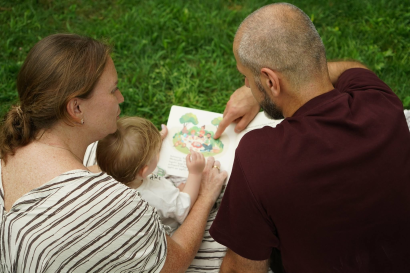
Daria has founded a bilingual Georgian-English publishing company with two children’s books already available for sale
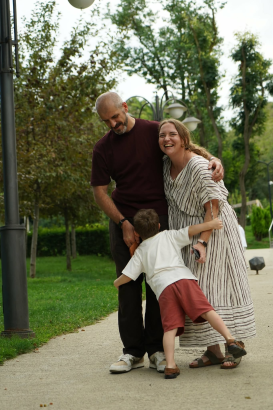
Daria and her Georgian husband are raising two boys
